
Taken from U of T Engineering News:
Neyhouse applies electrochemical engineering to design scalable processes for cleaner chemical manufacturing and sustainability
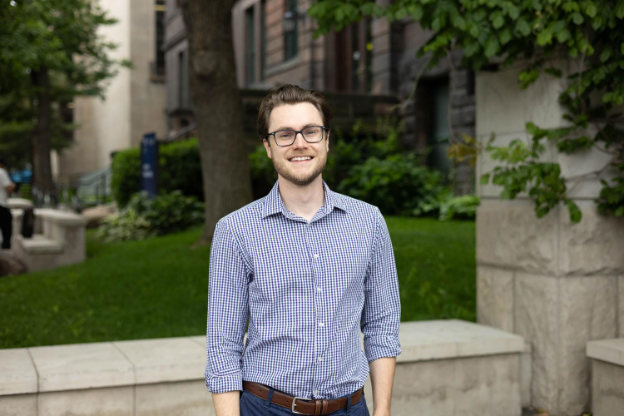
Professor Bertrand Neyhouse joined the Department of Chemical Engineering & Applied Chemistry (ChemE) at the University of Toronto in June 2025.
His research group applies fundamental chemical and electrochemical engineering principles to design and scale up electrosynthetic processes — with the goal of deploying electrochemistry to discover innovative, sustainable methods for converting a wide range of feedstocks into valuable chemical products.
Originally from Ohio, Neyhouse earned his undergraduate degree in chemical engineering at Ohio University, not to be confused with Ohio State. Drawn by his love of math and chemistry, he chose chemical engineering without fully knowing what it entailed — but quickly discovered its complexity and breadth. His growing curiosity led him to pursue a PhD at MIT, where he specialized in electrochemical engineering, followed by postdoctoral research at the University of Michigan to deepen and diversify his expertise.
We spoke with Neyhouse about his path to U of T, the challenges he hopes to tackle, and his approach to teaching and life beyond the lab.
What initially sparked your interest in electrochemical engineering?
I actually tripped and fell into electrochemical engineering as a first-year undergraduate. Research sounded interesting, so on a whim, I reached out to the Center for Electrochemical Engineering Research and ended up interviewing the next day.
From there, I had the chance to conduct undergraduate research spanning wastewater treatment, microbial sensors and carbon dioxide conversion. My mentors, Gerri Botte and Travis White, really inspired me — they showed me just how versatile, applied and fascinating this field can be.
How have your past experiences shaped your career path?
Growing up, I always thought I’d want to be a teacher. But when I started applying to universities, I leaned toward engineering to apply my love for math and chemistry to real-world technical challenges. You can imagine my excitement when I got to Ohio University and realized professors get to do both: teach and lead research.
I was fortunate to have instructors who were deeply passionate about chemical engineering education, setting examples I’ve aspired to follow ever since. That inspiration has guided me in pursuing this path and in my commitment to guiding the next generation of chemical engineers.
What drew you to U of T?
Beyond U of T’s reputation for high-impact research, I was especially drawn to the department’s strong commitment to sustainability. Even more compelling is how we tackle complex global challenges from a truly diverse range of perspectives — from microbiology and biochemical engineering to electrochemistry, catalysis and environmental science.
The collaborative research culture really stood out to me as well: it provides a strong foundation for combining expertise across disciplines to develop practical solutions to big sustainability problems.
Are there specific challenges in your field that you’re eager to address?
Absolutely! Right now, there’s an explosion of interest in electrochemistry, and researchers are exploring a wide range of new chemical transformations. But many of these leading-edge developments are only tested at small batch scales, so we don’t know enough about how viable they’d be for industry.
My work aims to bridge these gaps by applying fundamental electrochemical engineering principles to design scalable chemical manufacturing pathways — ultimately leading to generalizable knowledge that supports process innovation.
How do you see your research contributing to the department’s broader goals?
My research is closely tied to sustainability and will help expand the department’s focus on cleaner chemical manufacturing, waste valorization and energy storage.
Ultimately, I hope my work contributes to building a more sustainable future by reducing environmental impact, conserving natural resources and slowing the progression of climate change.
How do you approach teaching, and what strategies do you use to engage students?
I want students to see the potential application behind every problem they approach. Chemical engineering fundamentals can sometimes feel abstract or aimless, but grounding them in real-world contexts helps give students focus and purpose.
I also like to give students space to discuss new ideas and example problems together before we work through them as a class. That reflection helps them identify what they understand — and where they might need to dig deeper — rather than just listening passively to a flow of information.
In terms of bringing research into the classroom, electrochemical technologies are really just specialized applications of chemical engineering; meaning there are rich examples that can be readily applied throughout the traditional chemical engineering curriculum.
What do you enjoy outside of work?
I’m typically up for anything — which means I have found myself with a lot of hobbies! I like to spend my free time hanging out with family and friends, hiking, camping, cycling, cooking, playing video and board games, watching and playing sports, exploring Toronto and traveling.
How do you balance your professional life with your personal interests?
I recognize and value the importance of balance in maintaining both a strong professional drive and a fulfilling personal life, so I’m intentional about setting aside time for family, friends and hobbies. It also helps that chemical engineering itself is a personal passion — when you love what you do, it often doesn’t feel like work!
Do any of your hobbies inspire your work?
Definitely. My passion for sustainability is closely tied to my love of nature — hiking, camping, cycling and traveling all remind me of what’s at stake. To protect the beautiful world (and country) we call home, we must find innovative ways to leverage resources and preserve our environment. This motivates me to keep pushing for cleaner, more sustainable technologies.